Monday, July 13, 2015

Rug Hooking

Image result for images of antique hooked rugs


RUG HOOKING
The earliest forebears of hooked rugs were the floor mats made in Yorkshire, England during the early part of the 19th century.  Workers in weaving mills were allowed to collect thrums, pieces of yarn that ran 9 inches (23cm) long.  These by-products were useless to the mill, and the weavers took them home and pulled the thrums through a backing.
Rug hooking as we know it today developed in North America, specifically along the Eastern Seaboard in New England in the United States and the Canadian Maritimes.  In its earliest years, rug hooking was a craft of poverty.  The vogue for floor coverings in the United States came about after 1830 when factories produced machine-made carpets for the rich.  Poor women began looking through their scrap bags for materials to employ in creating their own home-made floor coverings.  Women employed whatever materials they had available.  Girls from wealthy families were sent to school to learn embroidery and quilting; fashioning floor rugs and mats was never part of the curriculum.  Another sign that hooking was the pastime of the poor is the fact that popular ladies magazines in the 19th century never wrote about rug hooking.  It was considered a country craft in the days when the word country, used in this context, was derogatory.
Since hooking was a craft of poverty, rugmakers put to use whatever materials were available.  Antique hooked rugs were created on burlap after 1850 because burlap was free as long as one used OLD GRAIN AND FEED BAGS.  Every and any scrap of fiber that was no longer usable as clothing was put into rugs.  In the United States, yarn was not a fiber of choice if one did not have access to thrums.  Yarn was too precious, and had to be saved for knitting and weaving.  Instead the tradition of using scraps of fabric evolved.  Yarns and other creatively used materials have always been used for hooked rugs in the Canadian Maritimes.
Traditional Rug Hooking is a craft where rugs are made by pulling loops of yarn or fabric through a stiff woven base such as burlap, linen, or rug warp.  The loops are pulled through the backing material by using a crochet hook mounted in a handle (usually wood) for leverage.
The modern preference for using only cut wool strips in hooked rugs originated with Pearl McGown in the 1930s, and may have saved the craft from disappearing in the United States.


www.buchanoncountyhistory.com

Friday, October 3, 2014

Bittersweet

 
Bittersweet
 

What is American Bittersweet Vine?

American bittersweet is a vigorous deciduous, perennial vine that grows 15 to 20 feet tall. It is native to central and eastern North America. They produce yellowish-green flowers that bloom in spring, but the flowers are plain and uninteresting compared to the berries that follow. As the flowers fade, orange-yellow capsules appear.
In late fall and winter, the capsules open at the ends to display the bright red berries inside. The berries remain on the plant well into winter, brightening winter landscapes and attracting birds and other wildlife. The berries are poisonous to humans if eaten, however, so practice caution when planting around homes with small children.


Info from www.gardeningknowhow.com


www.EarlyAmericanHome.net
www.pinterest.com/earamhom1
www.facebook.com/EarlyAmericanHome


Tuesday, May 27, 2014

 
The Garden Cloche


A cloche can loosely be defined as a structure that is placed over a plant to protect it from the cold.  The first mentioning of a cloche can be found around 1630 in a gardening treaty.  John Evelyn (1620-1706) mentioned bell glasses as a mandatory garden tool in his Elysium Britannicum, or The Royal Gardens or Three Books.

While these first cloches were developed by the French and made from glass, the Dutch and English quickly built upon this basic design.  These cultures created cloches that were in lantern and pyramid style. The basic material was the same but the glass panes were held into place with iron frames.
Those who could not afford the expense of glass cloches were not deprived of this important tool.  Cloches made from straw could be found throughout many colonial fields.

Cloches throughout history have been very important in plant protection.  A basic cloche works by absorbing heat during the day and releasing it at night.  This allows the gardener to put their crops out sooner and harvest sooner.  But the story does not end there.  To prevent your plants from getting too hot during the day and cooking, one must vent it in some fashion.  Glass bell cloches need to be removed from the plant before the sun hits it or place bricks around the plant and set the bell cloche on the bricks.  These bricks will create a vent by which excess heat can be released.


Information from:  site.outdora.com


Saturday, March 29, 2014

Colonial Gardening

 
Colonial Gardening


 Colonial gardens of 17th and 18th century America were as varied as the gardeners themselves and the locations in which they lived. While some gardens followed no plan, others were intricately laid out. Some gardens had plants designated to specific areas, while others were planted in a seemingly haphazard manner mixing tall plants with short ones, flowers with vegetables, and herbs mixed in amongst them all. Garden beds, varying in size and shape according to what was grown in them, were often raised by building up the soil and placing tree saplings on the ground around them. The purpose of raising the beds was to improve drainage, which garnered much attention. Walkways were usually made of tamped soil, gravel, clamshells, or brick, and were just wide enough for one person to walk through and weed the beds. The main walkways were, however, wider because they led to an outbuilding, namely the privy, located at the farthest end of the garden.

 Dutch gardens in New York, as well as those of merchants and townsmen of Virginia, were laid out in symmetrical patterns, yet were simple, functional, and well-balanced. Natural landscaping was seen as something that needed to be tamed and trimmed, not recreated, and resulted in gardens that resembled those of their homelands. Gardens were located near the kitchen house with walkways leading to many of the other outbuildings. The walkways were laid out geometrically in patterns such as basket weave, running bond, and herringbone and designed with either right angles or acute angles. Planting beds were “raised up” by boards allowing for good drainage, ease in planting, tending, and weeding.

 Fences were required by law as early as 1631. Legislation in 1646 set the minimum height of the fence at four and one-half feet and “close down to the bottom”. In 1705, the General Assembly enacted legislation to protect gardens from stray horses, mares, cattle, hogs, sheep, and goats. The fence had to be sturdy enough and so close that “none of the creatures aforesaid can creep through”. Post and rail fences, as well as picket fences, were typical for private gardens. The outlying borders of the fields were generally enclosed with a “worm” or “snake” fence, later known as the “Virginia rail”.

 Early colonists acquired seeds and plants by bringing them from their homelands, or through extensive exchanges across the Atlantic with friends and family. As a result, the majority of fruit trees, vegetables, herbs, and flowering bulbs came from Europe. Some plants such as the tomato and potato, although native to the Americas, came back to the colonies via these exchanges. These plants offered a sense of familiarity in an otherwise unfamiliar territory. Vegetables grown in the kitchen garden would have included leeks, onions, garlic, melons, English gourds, radishes, cabbages, and artichokes. Other vegetables that were needed in larger quantities like corn, beans, and pumpkins, were grown in the larger, outlying fields. Many vegetables and herbs served culinary, as well as, medicinal purposes while flowers were not only edible, but served as dyes and perfumes.

In summary, colonial gardens of the Dutch, merchants, and townsmen were simple, functional, symmetrical, and well-balanced in design while others were simply functional. Common features include raised beds, walkways, and an enclosure in the form of a “nature fence” or a wood fence to keep out stray livestock. Placement of these gardens was generally near the kitchen where they grew an assortment of vegetables, herbs, and flowers.


Taken from Colonial Gardening by Deb Browning

Wednesday, January 15, 2014

 
Tall Case Clocks
 
  Originally, tall case clocks were little more than wall or hang-up clocks. The transition to a tall case clock occurred in England from 1670 to 1700. It is likely that a hood was added to keep dust and dirt from the movement; later a case was added to hide the pendulum and weights. The craft of making tall case clocks in America began in Massachusetts and Pennsylvania and later in Connecticut; Connecticut became the birthplace of mass-produced clocks about 1840. Except in rare instances, the clockmaker did not make the cases for his clocks. Cases were usually made by a cabinetmaker on order from the clockmaker or from the purchaser of the movements. Each area developed its own regional style; one can distinguish between clocks made in Philadelphia, New York, or Boston. Generally speaking, case styles reflected the furniture styles of the period. Cases with flat tops, no feet, and square brass dials are of the William and Mary style. Between 1715 and 1725 arches appeared on the dial and hoods were arched to conform. The ogee foot appeared, and the style developed into that known as Queen Anne. The Chippendale style developed around 1760, broken arches became popular on the hoods and some fretwork was used, brass or wood finials appeared, and ogee feet became standard. (OG -- ogee -- is a molding found in both architecture and furniture.) Around 1780, the Hepple- white style appeared. The cases of this period often feature inlay work. Dials of tall case clocks are another way to date clocks. The earliest ones (1600 to about 1740) were about 10" square and made of brass with spandrels of pierced brass; usually a silvered chapter ring contained the numbers. With the advent of the arched dial, a moon phase often appeared in the lunette, which had carried the clockmaker's name. The painted dial appeared around 1780 along with Arabic numerals. Movements of tall case clocks were most often made of brass and ran for eight days. Some brass movements were of the pull-up variety, however, and ran for 30 hours.  Excerpt taken from:  A Brief History of American Clockmaking by Mo Klein  www.EarlyAmericanHome.netwww.EarlyAmericanHome.blogspot.com 

Saturday, December 14, 2013


The Blanket Chest
 
 
The blanket chest is used in much the same way today as it was in early America.
Whether antique or reproduction, a blanket chest can be a useful addition to a bedroom.
Placed at the end of a bed, it can store blankets for added warmth on cold nights.


The Blanket Chest
 
 
Blanket chests were very popular during the 17th thru 19th centuries. Over the years, drawers were added to the basic form, increasing the height, and gradually a different piece of furniture evolved called the mule chest. The drawers in a mule chest were used to store slippers called "mules" by the colonists.
The first colonists had no closets in which to store their clothing, blankets, and household linens. Attics were not readily accessible, and cellars were apt to be damp. Thus, the chest came into use.
In its simplest form, the chest was a large wooden box with a hinged lid. Although it functioned primarily as a receptacle for clothes and valuables, it also served as an additional seating place, for chairs were a luxury in most homes. Frequently chests were used for the storage of linens and things, especially those a bride brought to her husband. This is known as the dowry. From this evolved the name "hope" chest, now commonly used.
Early ships' records show the chests to have been the sole items of furniture accompanying many settlers. It is not surprising, therefore, that the chests built by seventeenth-century joiners in this country were copied from English pieces designed in the prevailing Jacobean style popular in London at that time. As early as 1660, craftsmen in Massachusetts and Connecticut were fashioning paneled and carved oak chests, constructed of wide stiles and rails. These had floating panels with elaborately carved intaglio decorations. Instead of a paneled top in the English fashion, the Colonial chest had a plain pine board top. This unadorned top surface was ideal for seating and did not need cushions thereby making it more functional.
In their crude fashion, these chests were the counterpart of the elaborate coffers, and caskets owned throughout Europe by wealthy families. Many households would not do without one of these blanket chests as few homes had a source of heat within the bedroom. On chilly nights it was convenient to merely go to the end of the bed and extract more bed covers to keep warm on those chilly nights. During warm seasons the blanket chest stored bed covers in a convenient location.
In colonial America blanket chests were constructed of various species of lumber ranging from inexpensive pines used for "country" type furniture to more expensive hardwoods such as walnut, cherry, and imported mahogany. The latter were used for more formal pieces of furniture that only the very wealthy could afford. Some of these chests were lined or constructed of pleasant smelling aromatic red cedar that repels insects. Pennsylvania Dutch chests were often hand painted with traditional decorative motifs.

The finish consists of six coats of hand-rubbed low luster tung oil finish, with a final coat of carnauba wax. The hardware consists of a high quality brass-plated, full-mortise chest lock, and friction scissor chest hinges that conveniently hold the top open.
This chest is certain to become a future antique, due to its traditional construction techniques, use of high quality materials, and timeless beauty.
 
 
Information taken from:  www.wwch.org


Friday, November 15, 2013

Thanksgiving


Thanksgiving


The arrival of the Pilgrims and Puritans brought new Thanksgiving traditions to the American scene. Today’s national Thanksgiving celebration is a blend of two traditions: the New England custom of rejoicing after a successful harvest, based on ancient English harvest festivals; and the Puritan Thanksgiving, a solemn religious observance combining prayer and feasting.

Florida, Texas, Maine and Virginia each declare itself the site of the First Thanksgiving and historical documents support the various claims. Spanish explorers and other English Colonists celebrated religious services of thanksgiving years before Mayflower arrived. However, few people knew about these events until the 20th century. They were isolated celebrations, forgotten long before the establishment of the American holiday, and they played no role in the evolution of Thanksgiving. But as James W. Baker states in his book, Thanksgiving: The Biography of an American Holiday, "despite disagreements over the details" the 3-day event in Plymouth in the fall of 1621 was "the historical birth of the American Thanksgiving holiday."

So how did the Pilgrims and Wampanoag come to be identified with the First Thanksgiving?


HARVEST HOME OR THANKSGIVING?
Pilgrim Colonists Hunting - Thanksgiving at Plymouth ColonyIn a letter from “E.W.” (Edward Winslow) to a friend in England, he says: “And God be praised, we had a good increase…. Our harvest being gotten in, our governor sent four men on fowling that so we might after a special manner rejoice together….” Winslow continues, “These things I thought good to let you understand… that you might on our behalf give God thanks who hath dealt so favourably with us.”
In 1622, without his approval, Winslow’s letter was printed in a pamphlet that historians commonly call Mourt’s Relation. This published description of the First Thanksgiving was lost during the Colonial period. It was rediscovered in Philadelphia around 1820. Antiquarian Alexander Young included the entire text in his Chronicles of the Pilgrim Fathers (1841). Reverend Young saw a similarity between his contemporary American Thanksgiving and the 1621 Harvest Feast. In the footnotes that accompanied Winslow’s letter, Young writes, “This was the first Thanksgiving, the harvest festival of New England. On this occasion they no doubt feasted on the wild turkey as well as venison.”

PURITAN HOLIDAY
The American Thanksgiving also has its origin in the faith practices of Puritan New England, where strict Calvinist doctrine sanctioned only the Sabbath, fast days and thanksgivings as religious holidays or “holy days.” To the Puritans, a true “thanksgiving” was a day of prayer and pious humiliation, thanking God for His special Providence. Auspicious events, such as the sudden ending of war, drought or pestilence, might inspire a thanksgiving proclamation. It was like having an extra Sabbath during the week. Fasts and thanksgivings never fell on a Sunday. In the early 1600s, they were not annual events. Simultaneously instituted in Plymouth, Connecticut and Massachusetts, Thanksgiving became a regular event by the middle of the 17th century and it was proclaimed each autumn by the individual Colonies.
Thanksgiving Dinner in the Civil WarW.S.L. Jewett, "A Thanksgiving Dinner Among Their Descendants," Harper's Weekly, 30 November 1867. Collection of Plimoth Plantation.
The holiday changed as the dogmatic Puritans of the 17th century evolved into the 18th century’s more cosmopolitan Yankees. By the 1700s, the emotional significance of the New England family united around a dinner table overshadowed the civil and religious importance of Thanksgiving. Carried by Yankee emigrants moving westward and the popular press, New England’s holiday traditions would spread to the rest of the nation.

NATIONAL FEAST
The Continental Congress proclaimed the first national Thanksgiving in 1777. A somber event, it specifically recommended “that servile labor and such recreations (although at other times innocent) may be unbecoming the purpose of this appointment [and should] be omitted on so solemn an occasion.”
Presidents Washington, Adams and Monroe proclaimed national Thanksgivings, but the custom fell out of use by 1815, after which the celebration of the holiday was limited to individual state observances. By the 1850s, almost every state and territory celebrated Thanksgiving.
Portrait of Sarah Josepha HaleSarah Josepha Hale (1788-1879). Many people felt that this family holiday should be a national celebration, especially Sarah Josepha Hale, the influential editor of the popular women’s magazine Godey’s Lady’s Book. In 1827, she began a campaign to reinstate the holiday after the model of the first Presidents. She publicly petitioned several Presidents to make it an annual event. Sarah Josepha Hale’s efforts finally succeeded in 1863, when she was able to convince President Lincoln that a national Thanksgiving might serve to unite a war-torn country. The President declared two national Thanksgivings that year, one for August 6 celebrating the victory at Gettysburg and a second for the last Thursday in November.
Neither Lincoln nor his successors, however, made the holiday a fixed annual event. A President still had to proclaim Thanksgiving each year, and the last Thursday in November became the customary date. In a controversial move, Franklin Delano Roosevelt lengthened the Christmas shopping season by declaring Thanksgiving for the next-to-the-last Thursday in November. Two years later, in 1941, Congress responded by permanently establishing the holiday as the fourth Thursday in the month. 


THE PILGRIM AND WAMPANOAG ROLE
The Pilgrims and the Wampanoag were not particularly identified with Thanksgiving until about 1900, though interest in the Pilgrims as historic figures began shortly before the American Revolution.
John and Prisicilla Alden Tableau, 1910Tableau of John and Priscilla Alden, 1910. Collection of Plimoth Plantation.
With the publication of Longfellow’s best-selling poem The Courtship of Miles Standish (1848) and the recovery of Governor Bradford’s lost manuscript Of Plimoth Plantation (1855), public interest in the Pilgrims and Wampanoag grew just as Thanksgiving became nationally important. Until the third quarter of the 19th century, music, literature and popular art concentrated on the Pilgrims’ landing at Plymouth Rock and their first encounters with Native People on Cape Cod.

After 1890, representations of the Pilgrims and the Wampanoag began to reflect a shift of interest to the 1621 harvest celebration. By the beginning of the 20th century, the Pilgrims and the Thanksgiving holiday were used to teach children about American freedom and how to be good citizens.

www.Plimoth.org


www.EarlyAmericanHome.net
Find us on Facebook


Wednesday, October 2, 2013

Pottery in Your Primitive/Colonial Home

 
Pottery in Your Primitive/Colonial Home


Pottery can be a useful addition to your country/primitive/colonial home.  Placed in a kitchen they can be used to store vegetables such as potatoes and onions.  Sitting on a countertop they are useful for holding cooking utensils such as wooden spoons.  A collector of early pottery might display their collection on an antique or reproduction crock bench. 
 
While American potteries are still producing pottery today, "antique" crocks will add an early feeling to your home.


Pottery in Colonial America

 
Pottery In Colonial America
Understanding the types of pottery that have been made in or imported to America can be difficult to sort through. Below is a thumbnail sketch of the most common types of pottery found in America during the 17th and 18th centuries along with a very brief technical description of each which, hopefully, will prove useful to the reader. 
 The average New England household in the 17th century could contain an assortment of ceramics from Europe, the Mediterranean and the Orient. Trade up and down the Atlantic coast was taking place among the Dutch, English and Spanish. The inventories of early 17th century New England households in the Boston area have shown to contain Dutch and English delft, Italian, Spanish and Portuguese maiolica (or majolica), porcelain,  imported redware and locally manufactured redware.
EARTHENWARE: All clays which have a porosity above 5% when fired are considered earthenwares. What this means is that the ability of a fired clay to hold liquids without seepage occurring must be within 5% of being completely water tight (vitrified). Earthenwares can range from pure white to dark brown in color. The texture of the clays can be fine grained to coarse. Generally, earthenwares fire to lower temperatures than either stoneware or porcelain. Earthenwares cannot be made absolutely water tight because of their porosity although the application of glaze to the pot does help. Some glazes work better than others in preventing seepage.
Redware is a type of earthenware. What causes the red color is the amount of iron in the clay body. Other minerals can affect the color as well but iron is the major mineral to affect color. Redwares can range from light orange to dark brown in color and the clay body can be fine grained to coarse. Redware clay deposits occur close to the surface and can be used as they are after processing. The color of the clay as it comes out of the ground can very greatly from the finished pot. Often, redware clays in New England are grey in color until after firing at which time many of them range from bright orange to deep red-brown.
During the 17th and 18th centuries, locally produced redware was usually utilitarian and sometimes of poor quality. From the 1680s through the Revolutionary War potters were restricted by the British from making fancier  wares and could only make the more basic forms such as chamber pots, pans, butter pots and other common pieces found in the kitchen and pantry. These types of wares were not economical to ship from Europe and so local production was tolerated. Refined redwares, most stoneware and all porcelain and tin-glazed wares were imported into the American colonies until the end of the Revolutionary War.
 Another reason for the lack of local production of more refined ceramics is due to the fact that outside of urban areas, potters were frequently farmers or involved in another livelihood besides pottery. The farmer/potter would make pottery during the times of year when the demands of farming were low. They provided a necessary service to their communities by supplying much needed wares. Skilled potters who emigrated to America usually worked in the urban areas where more jobs were available. The rural American potter was often self taught or taught by other potters who never had the benefit of learning the trade in one of the large well organized European centers. 
  
STONEWARE: Clay which can be fired within 2% of total vitrification  or less are considered to be stoneware. Stoneware clays are usually made up of blended clay bodies to produce a malleable, strong clay which can be worked on the pottersÕ wheel and fired to a vitreous state. Color and texture of stoneware clays can vary quite a lot. Color can range from white to dark brown and texture can be smooth to coarse. Salt glazing is a process whereby sodium, most often in the form of coarse salt, is introduced into the kiln during the firing. A chemical reaction between the clay body and the salt forms the pebbly, clear glaze. Although technically salt-glazing can be performed on certain earthenwares and porcelains, this process is most commonly used on stoneware. From an historic viewpoint, it can be assumed that a salt-glazed pot is made of stoneware.
Stonewares were imported from Europe to the American Colonies until the end of the Revolutionary War. Germany and England were the largest producers and exporters of stoneware. Both countries were producing grey salt glaze with blue decoration. The English added manganese purple as a decoration by the 18th century. Both countries also produced brown salt glaze. The German bellarmine jug and the English stein are the most common forms of brown salt glazed stoneware produced for foreign markets. American production began in the mid 18th century and both imitated and competed with the European imports despite trade restrictions. Large scale manufacture did not occur until immediately after the Revolutionary War. The large centers in the North spread from New Jersey and New York into New England. The southern centers were concentrated in Philadelphia and eastern Pennsylvania. Over time, more potteries started and began spreading further south. The tradition of salt glaze and alkaline glaze stoneware continued there well into the mid 19th century.

Information taken in part from: www.JuliaSmith.com

www.EarlyAmericanHome.net
www.Facebook.com/EarlyAmericanHome

Thursday, September 12, 2013

Open Hearth Cooking


Open Hearth Cooking
 
In the 1700's and 1800's many women cooked over an open fire. The days were long and the work was hard.  The number one cause of death in women during this time was fire related.  A long skirt could easily catch fire near the open hearth. 

18th Century Open Hearth Cooking


18th Century Open Hearth Cooking


RECIPES FROM THE PAST

Below-to give you an idea of the kind of roasting techniques that were once popular-are some recipes taken from the 1805 edition of Hannah Glasse's Art of Cookery (which was easily the most popular cookbook in 18th-century America).

RULES TO BE OBSERVED IN ROASTING

In the first place, take great care that the spit be very clean; and be sure to clean it with nothing but sand and water. Wash it clean, and wipe it dry with a cloth; for oil, brick-dust, and such things, will spoil your meat.

TO ROAST A PIGEON

Take some parsley shred fine, a piece of butter as big as a walnut, a little pepper and salt; tie the neck end tight; tie a string round the legs and rump, and fasten the other end to the top of the chimney-piece. Baste them with butter, and when they are [done] enough [elsewhere, she specifies 20 minutes] lay them in the dish, and they will swim with gravy [the natural roasting juices].

A TURKEY

A middling turkey will take an hour; a very large one, an hour and a quarter; a small one three quarters of an hour. You must paper the breast till it is near done enough, then take the paper off and froth it up. Your fire must be very good.
I've found that cooking-type parchment paper is best for this recipe, although ordinary typing paper will do in a pinch. A thin piece of pork flare fat tied on will also do. Foil, however, gives the meat a steamy" taste.
You'll notice that Ms. Glasse places great stress on having a brisk fire and recommends rather short cooking times. (Most of the old writers, in fact, suggest a mere 45 minutes to roast a large chicken or capon.) This is a far cry from the methods advocated by the present breed of home economists, who have us "roasting" our turkeys for hours on end at 300°F.
Of course, meats used to be cooked much rarer than they are now. Amelia Simmons-in her 1796 book, American Cookery (the first cookbook written by an American)—says firmly with regard to the roasting of beef that "rare done is the healthiest and [is] the taste of this age". Indeed it was, for Ms. Glasse wrote that a 10-pound piece of beef would be roasted in an hour and a half "at a good fire" (longer, in ''frosty weather").


Thursday, August 22, 2013

The Folk Art Portrait


The Folk Art Portrait
 
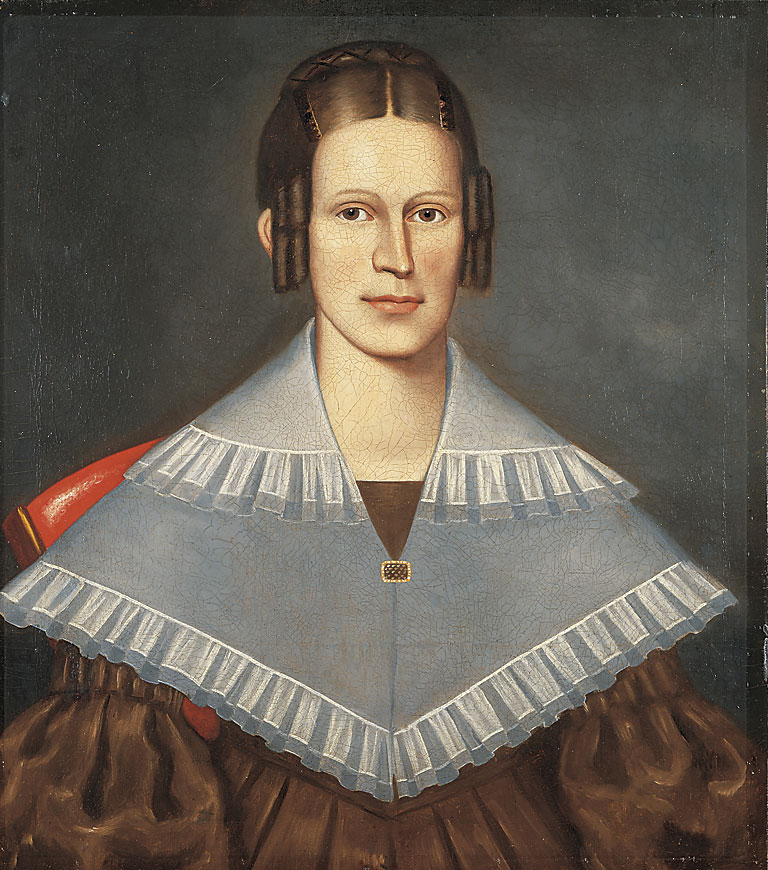
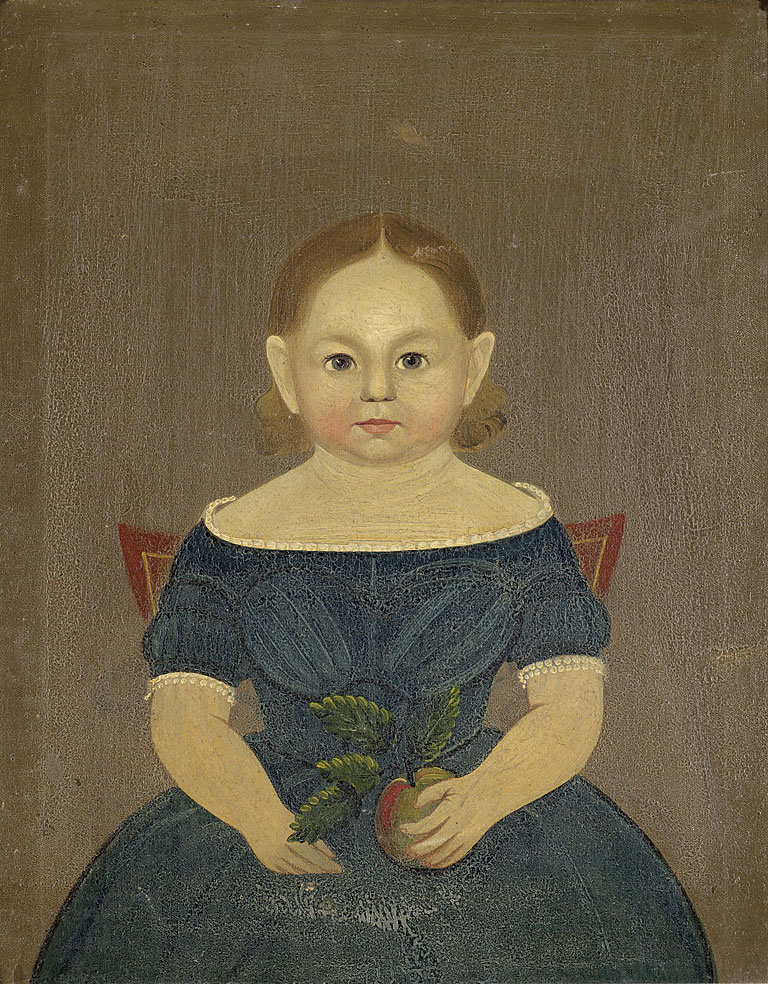
In arranging an authentic or believable room in your primitive/country home, the primitive folk art portrait is a welcome addition.  There are many folk art portraits reproduced today, each adding their own "style" to your room.  I have included examples of several folk art portraits. 


The Folk Art Portrait


The Folk Art Portrait
 

Primitive portraits were generally painted by itinerant artists who worked for food and lodging or who rented their facilities, staying in an area until all interested subjects had been painted before moving on. They occasionally advertised their services in newspapers, offering additional skills such as fancy, sign, and coach painting to broaden their potential for income. Some artists charged different rates depending on how much a sitter was willing to spend, which was reflected in whether the finished product had more or less realism and modeling. Some itinerant artists painted at a rate of two or three portraits per day, providing little opportunity to correct errors or attempt significant over-painting. Most of these artists did not sign their names. When they did, it was usually on the back of the canvas, with information about the sitter, location, or date. As a result, most attributions are based on rare signed examples, documents, or family histories.

 Primitive portraits usually show a linear format with flat facial features; a pose, frequently stiff, that is turned three-quarters or is fully frontal; minimal shadowing to indicate the direction of light; simplified versions of hands, ears, hair, and disproportionately sized heads; arms and legs extended from bodies in distorted directions; sometimes greater attention paid to details of clothing and backgrounds as compared to the face; backgrounds may be either plain and free of objects and scenery or, conversely, a fanciful rendition. Though artists had varying skills, with some having modest academic training, most primitive folk portraits exhibit some or all of the above characteristics. 
Primitive portrait painters occasionally used the same props in their images, "dressing" the sitters in the same outfits and reusing pieces of jewelry.

www.antiquesandfineart.com


Saturday, August 10, 2013

The Wingback Chair

The Wingback Chair


The wingback chair is an important piece for your country/primitive home.  The chair can be placed in a gathering room, as well as a bedroom.  Styles range from the primitive make-do wingback (such as the one pictured here) to the more formal traditional upholstered wingback.  There are many reproduction fabrics available for your wingback chair.  Choose a fabric that best suits the use of the chair and the style of your home.


History of the Wingback Chair

The Wingback Chair
 
Wing chairs are sometimes called fireside chairs, and for good reason. Their design is perfect for enjoying the warmth of a fire while your back and sides are protected from chilly drafts.
 
 
These chairs were not the earliest furniture to use this approach to keeping warm. Wings were also used on some of the high-backed wooden settles (benches) found in English manor houses and inns long before the new kind of upholstered chair brought an extra level of comfort to the late 17th century. We now know these as wing or wingback chairs.


Friday, July 19, 2013

Rag Rugs

 
Rag Rugs
 
Another type of floor covering used during Colonial times was a rag rug.  This rug was woven by hand using strips of old clothing, blankets, etc. that were no longer able to be used for their original purpose.  This style of  rug is used frequently today in the country, primitive, or period home. 


History of Rag Rugs

History ofWeaving Rag Rugs


History of Rag Rugs

These rugs originated in England and Europe, and in New England they became a
favored choice. Rag rugs are produced in a plain, flat weave style. Rag rugs are woven
on hand or machine looms where the weft is made of strips of cloth. They can be a solid
color or a mix of many colors. Rag rugs may consist of irregular stripes in bright cheerful
colors.
American rag rugs were a specialty in Colonial New England on the frontier during the
westward U.S. expansion movement. Rag rugs were made in Europe and as a practical
and vernacular floor covering, came to America with the early immigrants, and passed
down through the generations, mostly produced by recycling worn clothing or other
textiles. In the 1900’s rug making traditions were dispersed and sometimes modified to
take advantage of the local availability of materials. Different techniques flourished in
different sections of the country with woolen rugs becoming well established in New
England due to proximity of the woolen mills. Where railroads provided economical
transportation, wool and cotton fabrics produced on the east coast were made available
for rug making in other areas of the expanding U.S.
Rag scraps were a product which, sooner or later, everyone in America possessed.
The scraps were comprised of worn out fabric from old clothing, bedding, and
household furnishings that was too small or worn to continue in its previous function.
Flax and wool were the most prevalent raw materials, depending on the region, for the
rag rugs in the 18th century. Each material requires much time to process. Flax needed

months to grow, dry, and spin the fibers. Wool needed to be sheared; carded, or wiretoothed
brushed, used to disentangle wool fibers prior to spinning; spun; and shipped
from England. These were precious materials that could not be wasted, not even burlap
sacks could be wasted; they were used in many of the bases of rag rugs. The material
was cut into strips and converted into a rag rug. Rag rugs provided a way for
every household to have a floor covering or carpet to provide protection from drafts or
keep the floor clean and protected.
The 19th-century heyday of rag rugs, has left very few examples as they were not
treated as heirlooms. A new rug was often made each winter and the old ones rotated
around the house, from hearthrug to kitchen to back door, with the old doormat either
 
thrown away or used outside to cover the potato clump or compost heap. Thus very few
survived.
 
The types of rag rugs are categorized by weave and style. The most common were
hand woven rugs.