Thursday, August 22, 2013

The Folk Art Portrait


The Folk Art Portrait
 
In arranging an authentic or believable room in your primitive/country home, the primitive folk art portrait is a welcome addition.  There are many folk art portraits reproduced today, each adding their own "style" to your room.  I have included examples of several folk art portraits. 


The Folk Art Portrait


The Folk Art Portrait
 

Primitive portraits were generally painted by itinerant artists who worked for food and lodging or who rented their facilities, staying in an area until all interested subjects had been painted before moving on. They occasionally advertised their services in newspapers, offering additional skills such as fancy, sign, and coach painting to broaden their potential for income. Some artists charged different rates depending on how much a sitter was willing to spend, which was reflected in whether the finished product had more or less realism and modeling. Some itinerant artists painted at a rate of two or three portraits per day, providing little opportunity to correct errors or attempt significant over-painting. Most of these artists did not sign their names. When they did, it was usually on the back of the canvas, with information about the sitter, location, or date. As a result, most attributions are based on rare signed examples, documents, or family histories.

 Primitive portraits usually show a linear format with flat facial features; a pose, frequently stiff, that is turned three-quarters or is fully frontal; minimal shadowing to indicate the direction of light; simplified versions of hands, ears, hair, and disproportionately sized heads; arms and legs extended from bodies in distorted directions; sometimes greater attention paid to details of clothing and backgrounds as compared to the face; backgrounds may be either plain and free of objects and scenery or, conversely, a fanciful rendition. Though artists had varying skills, with some having modest academic training, most primitive folk portraits exhibit some or all of the above characteristics. 
Primitive portrait painters occasionally used the same props in their images, "dressing" the sitters in the same outfits and reusing pieces of jewelry.

www.antiquesandfineart.com


Saturday, August 10, 2013

The Wingback Chair

The Wingback Chair


The wingback chair is an important piece for your country/primitive home.  The chair can be placed in a gathering room, as well as a bedroom.  Styles range from the primitive make-do wingback (such as the one pictured here) to the more formal traditional upholstered wingback.  There are many reproduction fabrics available for your wingback chair.  Choose a fabric that best suits the use of the chair and the style of your home.


History of the Wingback Chair

The Wingback Chair
 
Wing chairs are sometimes called fireside chairs, and for good reason. Their design is perfect for enjoying the warmth of a fire while your back and sides are protected from chilly drafts.
 
 
These chairs were not the earliest furniture to use this approach to keeping warm. Wings were also used on some of the high-backed wooden settles (benches) found in English manor houses and inns long before the new kind of upholstered chair brought an extra level of comfort to the late 17th century. We now know these as wing or wingback chairs.


Friday, July 19, 2013

Rag Rugs

 
Rag Rugs
 
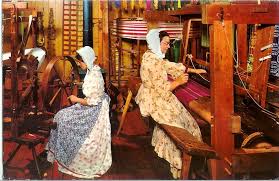
Another type of floor covering used during Colonial times was a rag rug.  This rug was woven by hand using strips of old clothing, blankets, etc. that were no longer able to be used for their original purpose.  This style of  rug is used frequently today in the country, primitive, or period home. 


History of Rag Rugs

History ofWeaving Rag Rugs


History of Rag Rugs

These rugs originated in England and Europe, and in New England they became a
favored choice. Rag rugs are produced in a plain, flat weave style. Rag rugs are woven
on hand or machine looms where the weft is made of strips of cloth. They can be a solid
color or a mix of many colors. Rag rugs may consist of irregular stripes in bright cheerful
colors.
American rag rugs were a specialty in Colonial New England on the frontier during the
westward U.S. expansion movement. Rag rugs were made in Europe and as a practical
and vernacular floor covering, came to America with the early immigrants, and passed
down through the generations, mostly produced by recycling worn clothing or other
textiles. In the 1900’s rug making traditions were dispersed and sometimes modified to
take advantage of the local availability of materials. Different techniques flourished in
different sections of the country with woolen rugs becoming well established in New
England due to proximity of the woolen mills. Where railroads provided economical
transportation, wool and cotton fabrics produced on the east coast were made available
for rug making in other areas of the expanding U.S.
Rag scraps were a product which, sooner or later, everyone in America possessed.
The scraps were comprised of worn out fabric from old clothing, bedding, and
household furnishings that was too small or worn to continue in its previous function.
Flax and wool were the most prevalent raw materials, depending on the region, for the
rag rugs in the 18th century. Each material requires much time to process. Flax needed

months to grow, dry, and spin the fibers. Wool needed to be sheared; carded, or wiretoothed
brushed, used to disentangle wool fibers prior to spinning; spun; and shipped
from England. These were precious materials that could not be wasted, not even burlap
sacks could be wasted; they were used in many of the bases of rag rugs. The material
was cut into strips and converted into a rag rug. Rag rugs provided a way for
every household to have a floor covering or carpet to provide protection from drafts or
keep the floor clean and protected.
The 19th-century heyday of rag rugs, has left very few examples as they were not
treated as heirlooms. A new rug was often made each winter and the old ones rotated
around the house, from hearthrug to kitchen to back door, with the old doormat either
 
thrown away or used outside to cover the potato clump or compost heap. Thus very few
survived.
 
The types of rag rugs are categorized by weave and style. The most common were
hand woven rugs.


Friday, July 5, 2013

Windsor Chairs

Windsor Chairs
 
 
Windsor chairs are an important addition to your primitive/country home to add an element of believability to your room.  A purest may prefer to find an antique Windsor chair, but there are many skilled craftspeople who create authentic-looking reproductions of the Windsor chairs and settles.  I have added a post on the History of the Windsor Chair if you would like further reading on them.