Friday, November 15, 2013

Thanksgiving


Thanksgiving


The arrival of the Pilgrims and Puritans brought new Thanksgiving traditions to the American scene. Today’s national Thanksgiving celebration is a blend of two traditions: the New England custom of rejoicing after a successful harvest, based on ancient English harvest festivals; and the Puritan Thanksgiving, a solemn religious observance combining prayer and feasting.

Florida, Texas, Maine and Virginia each declare itself the site of the First Thanksgiving and historical documents support the various claims. Spanish explorers and other English Colonists celebrated religious services of thanksgiving years before Mayflower arrived. However, few people knew about these events until the 20th century. They were isolated celebrations, forgotten long before the establishment of the American holiday, and they played no role in the evolution of Thanksgiving. But as James W. Baker states in his book, Thanksgiving: The Biography of an American Holiday, "despite disagreements over the details" the 3-day event in Plymouth in the fall of 1621 was "the historical birth of the American Thanksgiving holiday."

So how did the Pilgrims and Wampanoag come to be identified with the First Thanksgiving?


HARVEST HOME OR THANKSGIVING?
Pilgrim Colonists Hunting - Thanksgiving at Plymouth ColonyIn a letter from “E.W.” (Edward Winslow) to a friend in England, he says: “And God be praised, we had a good increase…. Our harvest being gotten in, our governor sent four men on fowling that so we might after a special manner rejoice together….” Winslow continues, “These things I thought good to let you understand… that you might on our behalf give God thanks who hath dealt so favourably with us.”
In 1622, without his approval, Winslow’s letter was printed in a pamphlet that historians commonly call Mourt’s Relation. This published description of the First Thanksgiving was lost during the Colonial period. It was rediscovered in Philadelphia around 1820. Antiquarian Alexander Young included the entire text in his Chronicles of the Pilgrim Fathers (1841). Reverend Young saw a similarity between his contemporary American Thanksgiving and the 1621 Harvest Feast. In the footnotes that accompanied Winslow’s letter, Young writes, “This was the first Thanksgiving, the harvest festival of New England. On this occasion they no doubt feasted on the wild turkey as well as venison.”

PURITAN HOLIDAY
The American Thanksgiving also has its origin in the faith practices of Puritan New England, where strict Calvinist doctrine sanctioned only the Sabbath, fast days and thanksgivings as religious holidays or “holy days.” To the Puritans, a true “thanksgiving” was a day of prayer and pious humiliation, thanking God for His special Providence. Auspicious events, such as the sudden ending of war, drought or pestilence, might inspire a thanksgiving proclamation. It was like having an extra Sabbath during the week. Fasts and thanksgivings never fell on a Sunday. In the early 1600s, they were not annual events. Simultaneously instituted in Plymouth, Connecticut and Massachusetts, Thanksgiving became a regular event by the middle of the 17th century and it was proclaimed each autumn by the individual Colonies.
Thanksgiving Dinner in the Civil WarW.S.L. Jewett, "A Thanksgiving Dinner Among Their Descendants," Harper's Weekly, 30 November 1867. Collection of Plimoth Plantation.
The holiday changed as the dogmatic Puritans of the 17th century evolved into the 18th century’s more cosmopolitan Yankees. By the 1700s, the emotional significance of the New England family united around a dinner table overshadowed the civil and religious importance of Thanksgiving. Carried by Yankee emigrants moving westward and the popular press, New England’s holiday traditions would spread to the rest of the nation.

NATIONAL FEAST
The Continental Congress proclaimed the first national Thanksgiving in 1777. A somber event, it specifically recommended “that servile labor and such recreations (although at other times innocent) may be unbecoming the purpose of this appointment [and should] be omitted on so solemn an occasion.”
Presidents Washington, Adams and Monroe proclaimed national Thanksgivings, but the custom fell out of use by 1815, after which the celebration of the holiday was limited to individual state observances. By the 1850s, almost every state and territory celebrated Thanksgiving.
Portrait of Sarah Josepha HaleSarah Josepha Hale (1788-1879). Many people felt that this family holiday should be a national celebration, especially Sarah Josepha Hale, the influential editor of the popular women’s magazine Godey’s Lady’s Book. In 1827, she began a campaign to reinstate the holiday after the model of the first Presidents. She publicly petitioned several Presidents to make it an annual event. Sarah Josepha Hale’s efforts finally succeeded in 1863, when she was able to convince President Lincoln that a national Thanksgiving might serve to unite a war-torn country. The President declared two national Thanksgivings that year, one for August 6 celebrating the victory at Gettysburg and a second for the last Thursday in November.
Neither Lincoln nor his successors, however, made the holiday a fixed annual event. A President still had to proclaim Thanksgiving each year, and the last Thursday in November became the customary date. In a controversial move, Franklin Delano Roosevelt lengthened the Christmas shopping season by declaring Thanksgiving for the next-to-the-last Thursday in November. Two years later, in 1941, Congress responded by permanently establishing the holiday as the fourth Thursday in the month. 


THE PILGRIM AND WAMPANOAG ROLE
The Pilgrims and the Wampanoag were not particularly identified with Thanksgiving until about 1900, though interest in the Pilgrims as historic figures began shortly before the American Revolution.
John and Prisicilla Alden Tableau, 1910Tableau of John and Priscilla Alden, 1910. Collection of Plimoth Plantation.
With the publication of Longfellow’s best-selling poem The Courtship of Miles Standish (1848) and the recovery of Governor Bradford’s lost manuscript Of Plimoth Plantation (1855), public interest in the Pilgrims and Wampanoag grew just as Thanksgiving became nationally important. Until the third quarter of the 19th century, music, literature and popular art concentrated on the Pilgrims’ landing at Plymouth Rock and their first encounters with Native People on Cape Cod.

After 1890, representations of the Pilgrims and the Wampanoag began to reflect a shift of interest to the 1621 harvest celebration. By the beginning of the 20th century, the Pilgrims and the Thanksgiving holiday were used to teach children about American freedom and how to be good citizens.

www.Plimoth.org


www.EarlyAmericanHome.net
Find us on Facebook


Wednesday, October 2, 2013

Pottery in Your Primitive/Colonial Home

 
Pottery in Your Primitive/Colonial Home


Pottery can be a useful addition to your country/primitive/colonial home.  Placed in a kitchen they can be used to store vegetables such as potatoes and onions.  Sitting on a countertop they are useful for holding cooking utensils such as wooden spoons.  A collector of early pottery might display their collection on an antique or reproduction crock bench. 
 
While American potteries are still producing pottery today, "antique" crocks will add an early feeling to your home.


Pottery in Colonial America

 
Pottery In Colonial America
Understanding the types of pottery that have been made in or imported to America can be difficult to sort through. Below is a thumbnail sketch of the most common types of pottery found in America during the 17th and 18th centuries along with a very brief technical description of each which, hopefully, will prove useful to the reader. 
 The average New England household in the 17th century could contain an assortment of ceramics from Europe, the Mediterranean and the Orient. Trade up and down the Atlantic coast was taking place among the Dutch, English and Spanish. The inventories of early 17th century New England households in the Boston area have shown to contain Dutch and English delft, Italian, Spanish and Portuguese maiolica (or majolica), porcelain,  imported redware and locally manufactured redware.
EARTHENWARE: All clays which have a porosity above 5% when fired are considered earthenwares. What this means is that the ability of a fired clay to hold liquids without seepage occurring must be within 5% of being completely water tight (vitrified). Earthenwares can range from pure white to dark brown in color. The texture of the clays can be fine grained to coarse. Generally, earthenwares fire to lower temperatures than either stoneware or porcelain. Earthenwares cannot be made absolutely water tight because of their porosity although the application of glaze to the pot does help. Some glazes work better than others in preventing seepage.
Redware is a type of earthenware. What causes the red color is the amount of iron in the clay body. Other minerals can affect the color as well but iron is the major mineral to affect color. Redwares can range from light orange to dark brown in color and the clay body can be fine grained to coarse. Redware clay deposits occur close to the surface and can be used as they are after processing. The color of the clay as it comes out of the ground can very greatly from the finished pot. Often, redware clays in New England are grey in color until after firing at which time many of them range from bright orange to deep red-brown.
During the 17th and 18th centuries, locally produced redware was usually utilitarian and sometimes of poor quality. From the 1680s through the Revolutionary War potters were restricted by the British from making fancier  wares and could only make the more basic forms such as chamber pots, pans, butter pots and other common pieces found in the kitchen and pantry. These types of wares were not economical to ship from Europe and so local production was tolerated. Refined redwares, most stoneware and all porcelain and tin-glazed wares were imported into the American colonies until the end of the Revolutionary War.
 Another reason for the lack of local production of more refined ceramics is due to the fact that outside of urban areas, potters were frequently farmers or involved in another livelihood besides pottery. The farmer/potter would make pottery during the times of year when the demands of farming were low. They provided a necessary service to their communities by supplying much needed wares. Skilled potters who emigrated to America usually worked in the urban areas where more jobs were available. The rural American potter was often self taught or taught by other potters who never had the benefit of learning the trade in one of the large well organized European centers. 
  
STONEWARE: Clay which can be fired within 2% of total vitrification  or less are considered to be stoneware. Stoneware clays are usually made up of blended clay bodies to produce a malleable, strong clay which can be worked on the pottersÕ wheel and fired to a vitreous state. Color and texture of stoneware clays can vary quite a lot. Color can range from white to dark brown and texture can be smooth to coarse. Salt glazing is a process whereby sodium, most often in the form of coarse salt, is introduced into the kiln during the firing. A chemical reaction between the clay body and the salt forms the pebbly, clear glaze. Although technically salt-glazing can be performed on certain earthenwares and porcelains, this process is most commonly used on stoneware. From an historic viewpoint, it can be assumed that a salt-glazed pot is made of stoneware.
Stonewares were imported from Europe to the American Colonies until the end of the Revolutionary War. Germany and England were the largest producers and exporters of stoneware. Both countries were producing grey salt glaze with blue decoration. The English added manganese purple as a decoration by the 18th century. Both countries also produced brown salt glaze. The German bellarmine jug and the English stein are the most common forms of brown salt glazed stoneware produced for foreign markets. American production began in the mid 18th century and both imitated and competed with the European imports despite trade restrictions. Large scale manufacture did not occur until immediately after the Revolutionary War. The large centers in the North spread from New Jersey and New York into New England. The southern centers were concentrated in Philadelphia and eastern Pennsylvania. Over time, more potteries started and began spreading further south. The tradition of salt glaze and alkaline glaze stoneware continued there well into the mid 19th century.

Information taken in part from: www.JuliaSmith.com

www.EarlyAmericanHome.net
www.Facebook.com/EarlyAmericanHome

Thursday, September 12, 2013

Open Hearth Cooking


Open Hearth Cooking
 
In the 1700's and 1800's many women cooked over an open fire. The days were long and the work was hard.  The number one cause of death in women during this time was fire related.  A long skirt could easily catch fire near the open hearth. 

18th Century Open Hearth Cooking


18th Century Open Hearth Cooking


RECIPES FROM THE PAST

Below-to give you an idea of the kind of roasting techniques that were once popular-are some recipes taken from the 1805 edition of Hannah Glasse's Art of Cookery (which was easily the most popular cookbook in 18th-century America).

RULES TO BE OBSERVED IN ROASTING

In the first place, take great care that the spit be very clean; and be sure to clean it with nothing but sand and water. Wash it clean, and wipe it dry with a cloth; for oil, brick-dust, and such things, will spoil your meat.

TO ROAST A PIGEON

Take some parsley shred fine, a piece of butter as big as a walnut, a little pepper and salt; tie the neck end tight; tie a string round the legs and rump, and fasten the other end to the top of the chimney-piece. Baste them with butter, and when they are [done] enough [elsewhere, she specifies 20 minutes] lay them in the dish, and they will swim with gravy [the natural roasting juices].

A TURKEY

A middling turkey will take an hour; a very large one, an hour and a quarter; a small one three quarters of an hour. You must paper the breast till it is near done enough, then take the paper off and froth it up. Your fire must be very good.
I've found that cooking-type parchment paper is best for this recipe, although ordinary typing paper will do in a pinch. A thin piece of pork flare fat tied on will also do. Foil, however, gives the meat a steamy" taste.
You'll notice that Ms. Glasse places great stress on having a brisk fire and recommends rather short cooking times. (Most of the old writers, in fact, suggest a mere 45 minutes to roast a large chicken or capon.) This is a far cry from the methods advocated by the present breed of home economists, who have us "roasting" our turkeys for hours on end at 300°F.
Of course, meats used to be cooked much rarer than they are now. Amelia Simmons-in her 1796 book, American Cookery (the first cookbook written by an American)—says firmly with regard to the roasting of beef that "rare done is the healthiest and [is] the taste of this age". Indeed it was, for Ms. Glasse wrote that a 10-pound piece of beef would be roasted in an hour and a half "at a good fire" (longer, in ''frosty weather").


Thursday, August 22, 2013

The Folk Art Portrait


The Folk Art Portrait
 
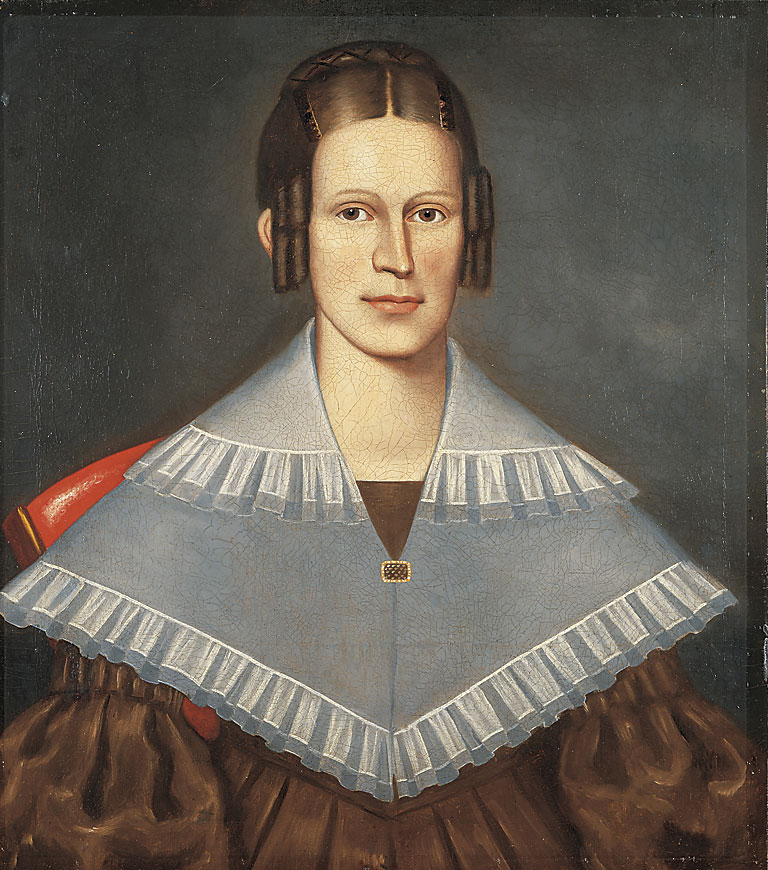
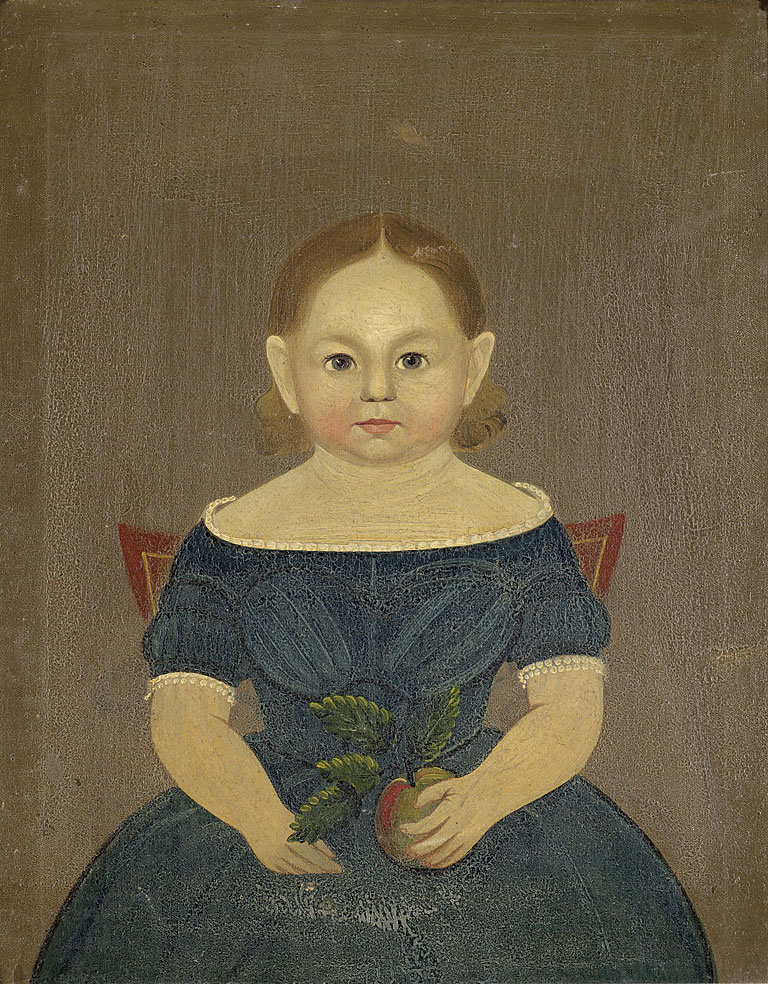
In arranging an authentic or believable room in your primitive/country home, the primitive folk art portrait is a welcome addition.  There are many folk art portraits reproduced today, each adding their own "style" to your room.  I have included examples of several folk art portraits. 


The Folk Art Portrait


The Folk Art Portrait
 

Primitive portraits were generally painted by itinerant artists who worked for food and lodging or who rented their facilities, staying in an area until all interested subjects had been painted before moving on. They occasionally advertised their services in newspapers, offering additional skills such as fancy, sign, and coach painting to broaden their potential for income. Some artists charged different rates depending on how much a sitter was willing to spend, which was reflected in whether the finished product had more or less realism and modeling. Some itinerant artists painted at a rate of two or three portraits per day, providing little opportunity to correct errors or attempt significant over-painting. Most of these artists did not sign their names. When they did, it was usually on the back of the canvas, with information about the sitter, location, or date. As a result, most attributions are based on rare signed examples, documents, or family histories.

 Primitive portraits usually show a linear format with flat facial features; a pose, frequently stiff, that is turned three-quarters or is fully frontal; minimal shadowing to indicate the direction of light; simplified versions of hands, ears, hair, and disproportionately sized heads; arms and legs extended from bodies in distorted directions; sometimes greater attention paid to details of clothing and backgrounds as compared to the face; backgrounds may be either plain and free of objects and scenery or, conversely, a fanciful rendition. Though artists had varying skills, with some having modest academic training, most primitive folk portraits exhibit some or all of the above characteristics. 
Primitive portrait painters occasionally used the same props in their images, "dressing" the sitters in the same outfits and reusing pieces of jewelry.

www.antiquesandfineart.com